
The Danube and the sea · Constanța
Constanța and the Greek city of Histria
Romania's biggest port sits on top of ancient Tomis, and an hour up the coast the stones of Histria, the oldest town in the country, lie beside a lagoon that was once the open sea.
Constanța is Romania's main port and its gateway to the Black Sea, a working city of cranes, apartment blocks and long beaches spread around an old town on a small headland. That headland is where the story starts. Greek colonists founded Tomis here, and later it became a Roman town, the place where the poet Ovid was sent into exile and where he wrote his late, homesick verse. The modern city grew up on top of all of it, and you keep finding the older layers under your feet.
The region around it is Dobruja, the strip of land between the lower Danube and the sea. It was under Ottoman rule for centuries and joined Romania in 1878, and its past shows in the mix of people and buildings: Orthodox churches, mosques, a small Turkish and Tatar community, Greek and Armenian traces in the old streets.
The old town on the headland
Start in Piața Ovidiu, Ovid Square, where a bronze statue of the poet stands in front of the history and archaeology museum. The museum holds finds from Tomis and the rest of Dobruja, including carved stone figures found buried in the city. A short walk away, below the square on the slope towards the port, is the Roman mosaic building: the remains of a large public building with a broad floor of coloured mosaic, laid in the late Roman period, when Tomis was a busy harbour town. It is one of the largest Roman mosaic floors found in this part of Europe, and it is protected by a modern cover. Parts of the site have been closed for conservation at times.
The streets of the old town are a mix of fine houses in need of repair, restored facades, small churches and quiet corners. Near the tip of the headland stands the Orthodox cathedral of Saints Peter and Paul, and a little further on the seafront promenade begins, with views out over the breakwaters to the ships waiting offshore.
The Great Mosque
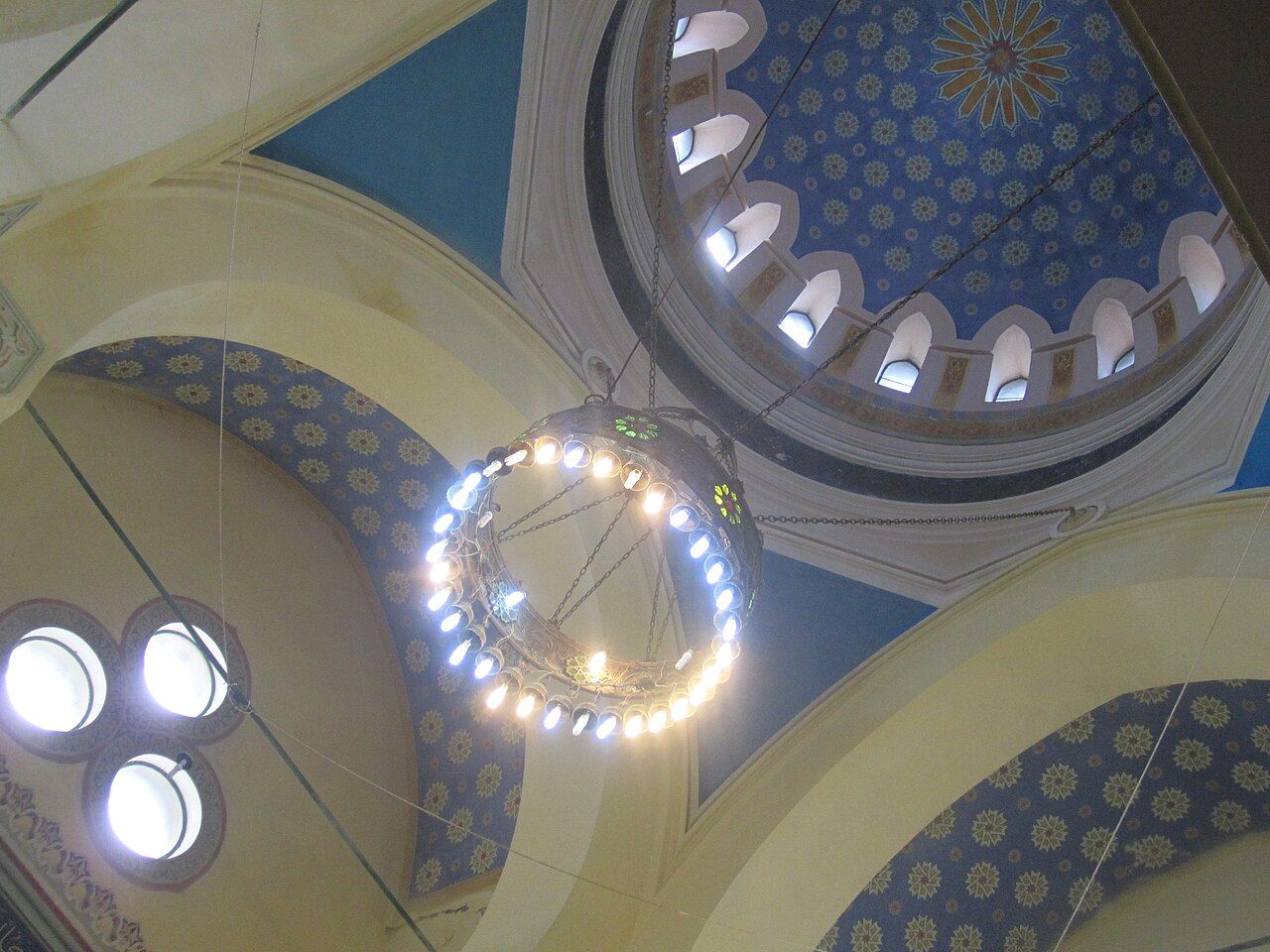
The tall minaret on the skyline belongs to the Great Mosque, built in the early 20th century and named for King Carol, the Romanian king who reigned at the time. It was one of the first large buildings in the country to use reinforced concrete, and its style mixes Ottoman and Egyptian ideas with the engineering of its day. Inside, a dome painted in blues and greens rises over a single prayer hall.
The mosque serves the Muslim community of Dobruja, mostly Turkish and Tatar families who have lived on this coast for generations. Visitors are usually welcome outside prayer times. Dress modestly, take off your shoes where asked, and women may be offered a headscarf. When it is open, a climb up the narrow stair of the minaret gives you the best view in the city: the old town, the port, the casino and the sea.
The casino on the seafront
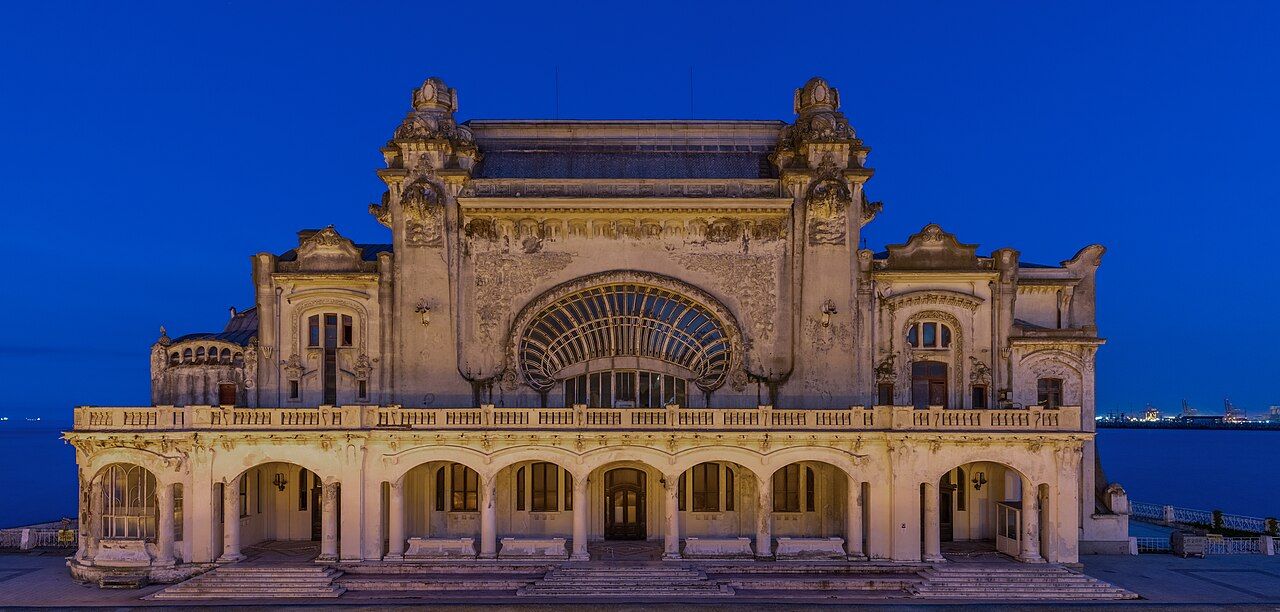
The building on every postcard of Constanța is the casino, an Art Nouveau palace standing on its own at the edge of the water. It was finished around 1910, in the years when the city was becoming a fashionable resort, and it was built for gambling, dancing and being seen. Its curved facade, carved shells and big arched window face the promenade, and the back of the building looks straight out to sea.
The casino's later life was harder. It served other purposes through the wars and the communist years, then stood empty for a long time while salt, wind and neglect wore at it. Restoration has been under way in recent years, and whether you can go inside, and how far, depends on how that work stands. Even from the outside it is worth the walk, especially early in the morning or at dusk, when the stone takes on the colour of the sky.
Further along the arcInto the Danube Delta
Out to Histria
Histria lies north of Constanța, about an hour's drive away, on the shore of Lake Sinoe. It was founded by Greek colonists from Miletus in the 7th century BC, which makes it the oldest town on the territory of modern Romania. For centuries it traded by sea, then it was rebuilt by the Romans and later by the Byzantines, each time inside a smaller set of walls. In the end the sea pulled away: sand and silt closed the harbour, the bay became a lagoon, and the town slowly died.
What you walk through today is a field of low walls, foundations and column bases on a slight rise, with the reed beds and water of the lagoon on one side. You can trace the late Roman defensive wall, the bath houses, the basilicas and the old sacred area where the Greek temples stood. A site museum near the entrance shows pottery, inscriptions and small finds. There is very little shade, and in summer the heat comes up off the stones, so go early in the day and carry water.
The lagoons and marshes around Histria belong to the protected landscape that runs north to the Danube Delta, and the birdlife is part of the visit: herons, cormorants and, in the warmer months, the occasional pelican overhead. If you are travelling by public transport, Histria is awkward to reach without a car, and many people combine it with a drive along the lakes.
The Black Sea season
The sea is the reason most people come. The beaches run north and south of the city, with the long resort strip of Mamaia on a sandbar between the sea and a lake, and a chain of smaller resorts to the south towards the border with Bulgaria. The season is short and intense: the water is warm enough for most swimmers from about June to early September, July and August are crowded, and outside summer many beach businesses close.
The coast is an easy add-on to a trip that starts in Bucharest, and the road and the railway across the Danube both lead here. For the ways to arrange that, see getting around the two countries. Spring and early autumn are good times for the city and for Histria, with milder heat and fewer people, even if the sea is too cold for a long swim.
Whatever the month, treat the sea with respect. Currents can be strong on open beaches, and it is wise to swim where lifeguards are on duty and to follow the flags.
The photographs on this page are credited, with their licences, on threads and photographers.