
Bucharest and Wallachia · Curtea de Argeș
Curtea de Argeș and the legend of Master Manole
An early seat of the Wallachian princes keeps a carved white cathedral with a dark legend, the graves of Romania's kings and one of the oldest painted churches in the country.
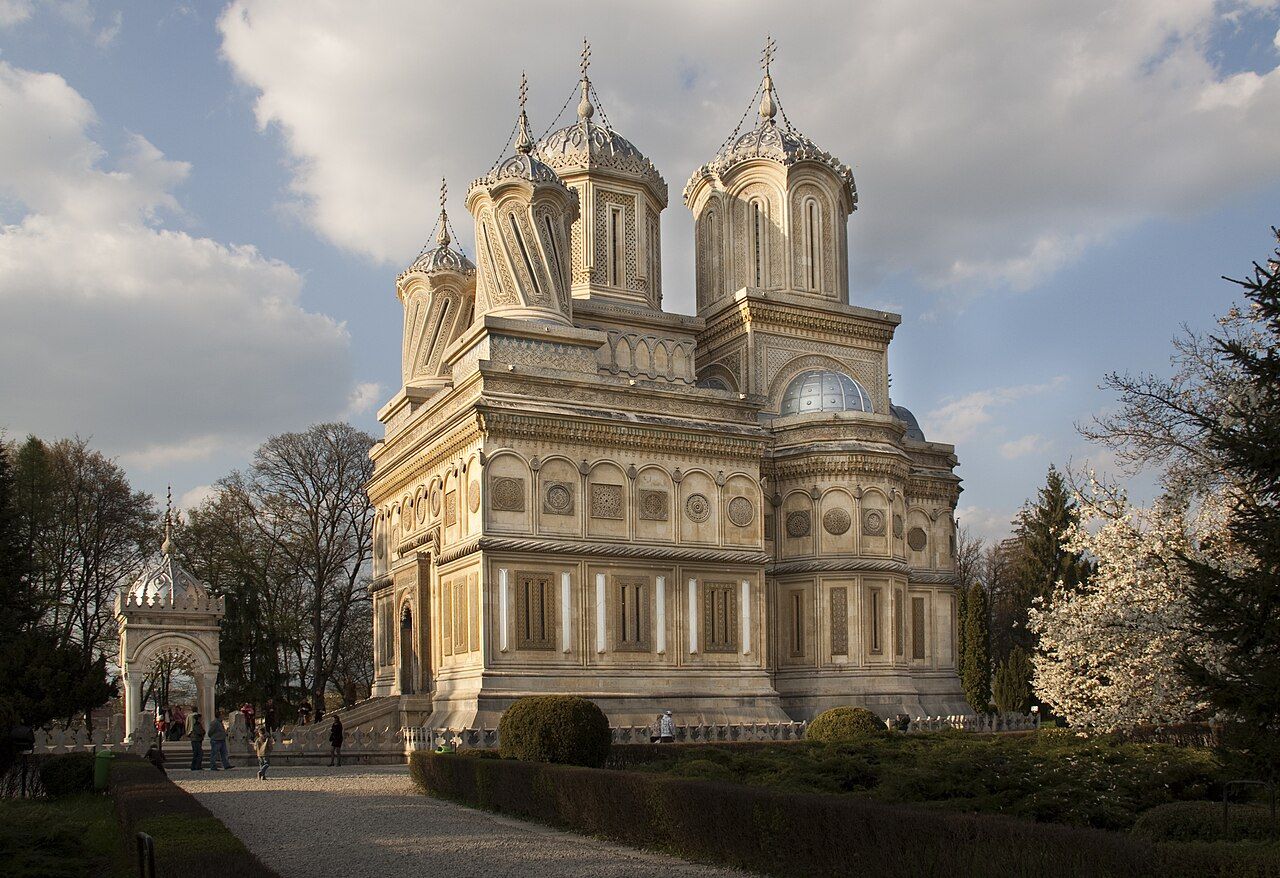
Curtea de Argeș is a quiet town on the Argeș river where the plain of Wallachia meets the first hills of the Carpathians. Its name means the court on the Argeș, and in the 14th century it was one of the early seats of the princes who founded Wallachia. Two churches from its past draw visitors today: the carved cathedral of the Argeș monastery, with its legend, and the much older Princely Church in the ruins of the old court.
The cathedral of Neagoe Basarab
The cathedral of the Argeș monastery was built between 1512 and 1517 for Neagoe Basarab, prince of Wallachia. It is unlike any other church in Romania. The outside is covered in carved stone: bands of rosettes, panels, cords and window frames, with two twisted towers at the west end and two straight ones beside them. The plan is compact, the walls are pale, and in sunlight the carving casts sharp shadows across the whole building.
What you see today is largely the result of a restoration in the late 19th century led by the French architect André Lecomte du Noüy. It saved the building but also replaced much of the old interior and its paintings, and the work has been criticised ever since. The outside, however, keeps its 16th-century form.
In front of the cathedral stands a small open pavilion for holy water, with carved arches and a painted dome. The church is part of a working monastery and the seat of an archbishop. Dress modestly, keep quiet inside, and follow the signs about photographs.

The legend of Master Manole
Every Romanian child knows the story of the building of this church, told in the ballad of Meșterul Manole. In it, the prince hires Manole and nine other master builders, but everything they raise by day falls down by night. Manole dreams that the walls will stand only if the builders wall up alive the first wife or sister to come to the site the next morning. The masters agree, and the first to arrive is Ana, Manole's own wife, bringing his food. He builds her into the wall while she pleads with him that it is pressing her.
When the church is finished, the prince asks the builders if they could make something even finer. They say they could, so he takes away the scaffolding and leaves them on the roof so that they will never build anything to rival it. They make wings from wooden shingles and jump, and all die. Where Manole fell, a spring rose. A well near the monastery is still pointed out as Manole's well.
The ballad is a version of a building sacrifice legend found across the Balkans, and it has nothing to do with the real history of the church. It is still the story that most people bring with them, and it is hard to look at the walls without thinking of it.
Further along the arcOver the TransfăgărășanThe royal tombs
Inside the cathedral lie the founders of modern Romania's royal family: Queen Elisabeth and her husband, King Carol I, and King Ferdinand and Queen Marie. Neagoe Basarab and members of his family are also buried here. In the 21st century a large new cathedral was built nearby to serve as the archbishop's seat and a new royal burial place, and King Michael I, the last king, who died in 2017, was buried there with Queen Anne. The two buildings together make the town the main royal burial place of the country.
If you have visited the summer castle of King Carol at Sinaia, standing by his grave here closes a circle.

The Princely Church
In the centre of the town, inside the low ruins of the old princely court, stands the Princely Church of St Nicholas, Biserica Domnească. It dates from the 14th century, and it is one of the oldest buildings in Wallachia that is still in use. The outside is plain, built in bands of stone and brick in a Byzantine style. Inside, the walls are covered with frescoes from the same century, including portraits of the early princes, faded but clear. They are among the most important medieval paintings in Romania.
The church is smaller and darker than the cathedral and much less visited. Give your eyes a minute to adjust in the half-light, and you will see the figures of saints, prophets and princes appear around you.
The road north
Curtea de Argeș sits at the foot of the road that leads north up the Argeș valley. A short drive brings you to the Vidraru Dam and the ruins of Poenari fortress, tied to Vlad III Dracula, and beyond them the road climbs over the mountains as the Transfăgărășan to Bâlea Lake and Transylvania.
The town is small enough for a half day, but staying a night lets you see the cathedral in the evening light and start early on the mountain road. Bears live in the forests of the Argeș valley: never feed them, keep your distance, and follow local warnings. From the south, Pitești is the nearest large town, on the motorway from Bucharest.
The photographs on this page are credited, with their licences, on threads and photographers.