
Transylvania · Cluj-Napoca
Cluj-Napoca, the university city
Transylvania's student city, where a Gothic church faces a Hungarian king's statue, Romanian and Hungarian histories share the same streets, and an old salt mine waits an hour to the south.
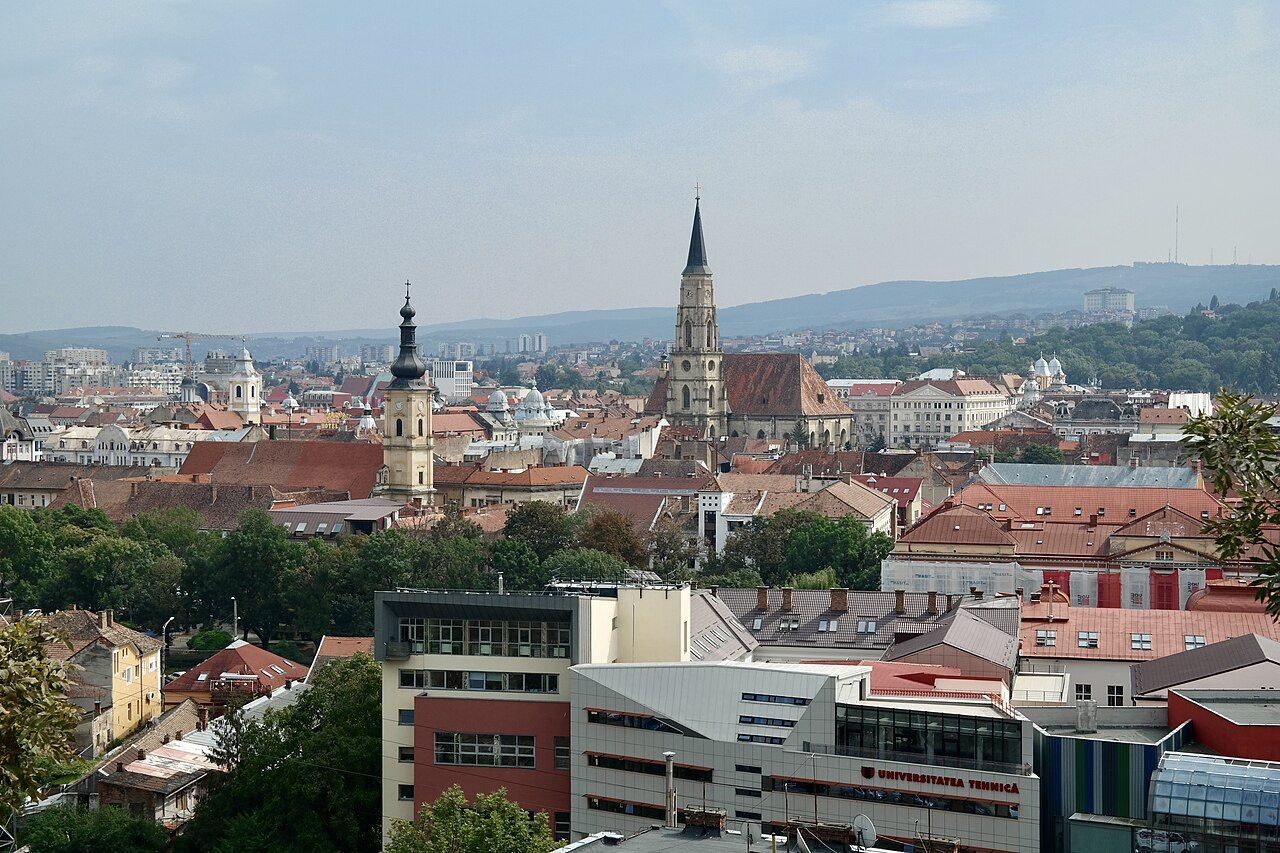
Cluj-Napoca spreads along the Someșul Mic river in the north-west of Transylvania, one of the largest cities in Romania and the unofficial capital of the region. It was the Roman town of Napoca, then Kolozsvár to Hungarians and Klausenburg to Germans, and for most of its history Cluj to Romanians. The Napoca was added to its name in 1974, under communist rule, to stress its Roman roots. Today it is a university city first, with tens of thousands of students, a growing technology industry and a busy calendar of music and film.
The old centre is compact, and its broad squares and long streets are easy to walk. The city's character comes less from single monuments than from the mix: Gothic and Baroque churches, Habsburg-era palaces, Orthodox domes, student cafes and the sound of two languages.
Unirii Square and St Michael's
Piața Unirii, Union Square, is the heart of the old town. In its centre stands St Michael's Church, a large Gothic Roman Catholic church built over the 14th and 15th centuries, with a tall neo-Gothic tower added in the 19th. Inside, the long nave and high vaults are among the finest Gothic spaces in Transylvania. Beside the church rides the bronze statue of Matthias Corvinus, the 15th-century king of Hungary, who was born in Cluj; the house where he is said to have been born stands on a street close by.
On the east side of the square, the Baroque Bánffy Palace holds the National Museum of Art. The streets leading off the square are lined with townhouses, courtyards and arcades, many now given over to the university, to bookshops and to small galleries.
Two histories, one city
Cluj has long been home to both Romanians and Hungarians, and for centuries it was a Hungarian cultural centre within Transylvania. After 1918, when Transylvania became part of Romania, the balance shifted, and today Romanians are the majority while a sizeable Hungarian community keeps its own churches, schools, theatre and opera. The Babeș-Bolyai University, whose name joins a Romanian and a Hungarian scientist, teaches in Romanian, Hungarian and German.
You can read the two histories in the streets. Avram Iancu Square, a short walk east of Unirii Square, holds the large Orthodox Metropolitan Cathedral, built between the two world wars, and the National Theatre facing it, while Hungarian Reformed and Catholic churches stand a few streets away. In the 1990s the city's politics were openly divided along national lines; today the mood is calmer, and the two communities share the same squares and the same student life.
Further along the arcThe Saxon fortified churchesGardens and hills
South of the centre, the Alexandru Borza Botanical Garden belongs to the university and spreads over a hillside, with greenhouses, a Japanese garden, a Roman garden and collections of plants from around the world. It is one of the largest botanical gardens in south-eastern Europe and a calm place on a warm afternoon. Closer to the river, the Central Park has a lake, shady paths and an old casino building used for events.
For a view, climb Cetățuia hill north of the river, the site of an 18th-century Habsburg fortress. From the top you look across the roofs to the spire of St Michael's and the domes of the Orthodox cathedral, with the hills of the Transylvanian plateau beyond. It is a short but steep walk, and the best time is late in the day.

The salt mine at Turda
About an hour south-east of Cluj by road, the town of Turda has one of the most unusual sights in Romania. Salina Turda is an old salt mine, worked for centuries and closed to mining in the early 20th century, which has been turned into a place to visit. You enter through a long, straight access tunnel cut through the salt, then descend into huge chambers carved out by generations of miners. The largest has been fitted with lights, a small wheel and games, and in another a lake lies at the bottom, where you can take a rowing boat.

The air stays cool and damp all year, so bring a warm layer even in summer, and wear shoes with grip, as the floors and stairs can be wet. Expect queues on summer weekends. Nearby, the Turda Gorge, Cheile Turzii, is a narrow limestone gorge with a marked path through it, good for a half day of walking.
Routes to Cluj-Napoca
Cluj-Napoca has an international airport, a main railway station with connections across the country, and road links that have improved with new motorway sections. From Bucharest the journey by land is long, so many travellers split it, perhaps at Sighișoara on the way.
The centre is easy on foot, and buses and trolleybuses reach the outer districts. Cluj is also the natural gateway to the north: the wooden churches and villages of Maramureș are a few hours away. In term time and during the big summer festivals the city is full, and beds go quickly, so plan ahead.
The photographs on this page are credited, with their licences, on threads and photographers.