
Transylvania · Sibiu
Sibiu, the town with eyes in its roofs
Sibiu was Hermannstadt for most of its history, and its Saxon builders left two towns stacked on one slope, three linked squares and roofs that seem to watch you cross them.

Sibiu grew on a low ridge above the Cibin river, in the south of Transylvania, with the Făgăraș and Cindrel mountains on the skyline. For most of its history it was Hermannstadt, the chief town of the Transylvanian Saxons, German-speaking settlers who arrived in the 12th century at the invitation of the Hungarian crown. They built in stone and brick, walled the town several times over and organised it around guilds. The Saxon community is small today, after the large emigration to Germany that followed 1990, but the plan of the town is theirs, and you read it every time you climb a stair or cross a square.
The centre is compact enough to walk in a day and layered enough to fill three. It was restored with care in the years around 2007, when Sibiu shared the title of European Capital of Culture, and the work shows in clean facades, relaid paving and courtyards opened to the street.
Two towns on one slope
Sibiu is really two towns. The upper town holds the big squares, the churches and the merchants' houses. The lower town, down the slope towards the river, was where craftsmen, millers and tanners worked, and its streets are lower, narrower and more lived-in. The two are joined by steep lanes, stone stairways and passages that cut under buildings, and much of the pleasure of the place is moving between them on foot.
The Passage of Stairs, Pasajul Scărilor, drops from the area by the Evangelical Cathedral to the lower town beside a stretch of old wall. Strada Ocnei runs downhill beneath the Bridge of Lies. Take one route down and another back up and you will have seen both halves of the town and the seam between them.
The three squares
Piața Mare, the Large Square, is the formal heart. On one side stands the Brukenthal Palace, built for Samuel von Brukenthal, the 18th-century Habsburg governor of Transylvania, whose collection became one of the oldest public museums in this part of Europe. On another stands the Baroque Roman Catholic church built by the Jesuits, with the Council Tower, Turnul Sfatului, rising nearby. The tower can usually be climbed, and the view from the top takes in the whole square, the roofs of the lower town and, on a clear day, the mountains.
Through the passage under the tower you reach Piața Mică, the Small Square, which curves around the slope. Its arcaded houses were once guild halls and shops, and one of them now holds a museum of pharmacy. From its lower edge the Bridge of Lies, Podul Minciunilor, crosses over Strada Ocnei. It is a cast-iron footbridge from the middle of the 19th century, and several stories explain its name: that it creaks when someone on it tells a lie, that cheating merchants were thrown from it, that young couples made promises on it they did not keep. None of them can be proved, which suits a bridge with that name.
The third square, Piața Huet, is quieter and gathers around the Evangelical Cathedral, the great Gothic Lutheran church of the Saxons, with its tall tower and a lofty, sober interior lined with old memorial stones. A few streets away, the Orthodox Metropolitan Cathedral, built in the early 20th century, is a reminder that Sibiu was also an important centre of Romanian Orthodox life and learning.

The eyes in the roofs
Look up from almost anywhere in the old town and the roofs look back. The long, steep tiled roofs are cut by small curved dormers, half-closed slits shaped like eyelids, and from the street they read as rows of eyes watching the square. They are practical: the attics under those roofs were used to store grain, goods and household supplies, and the openings let air through while keeping out most of the rain and sun.
Look up from almost anywhere in the old town and the roofs look back.
The effect is strongest on the houses around Piața Mică and Piața Mare and in the courtyard of the old town hall on Strada Mitropoliei. That building, the Altemberger House, grew out of several Gothic houses joined together, served as the town hall for centuries and now holds the history museum. Its inner courtyard, with galleries on two sides and roofs full of eyes, is worth seeing even if you skip the exhibits.
Further along the arcBrașov under Tâmpa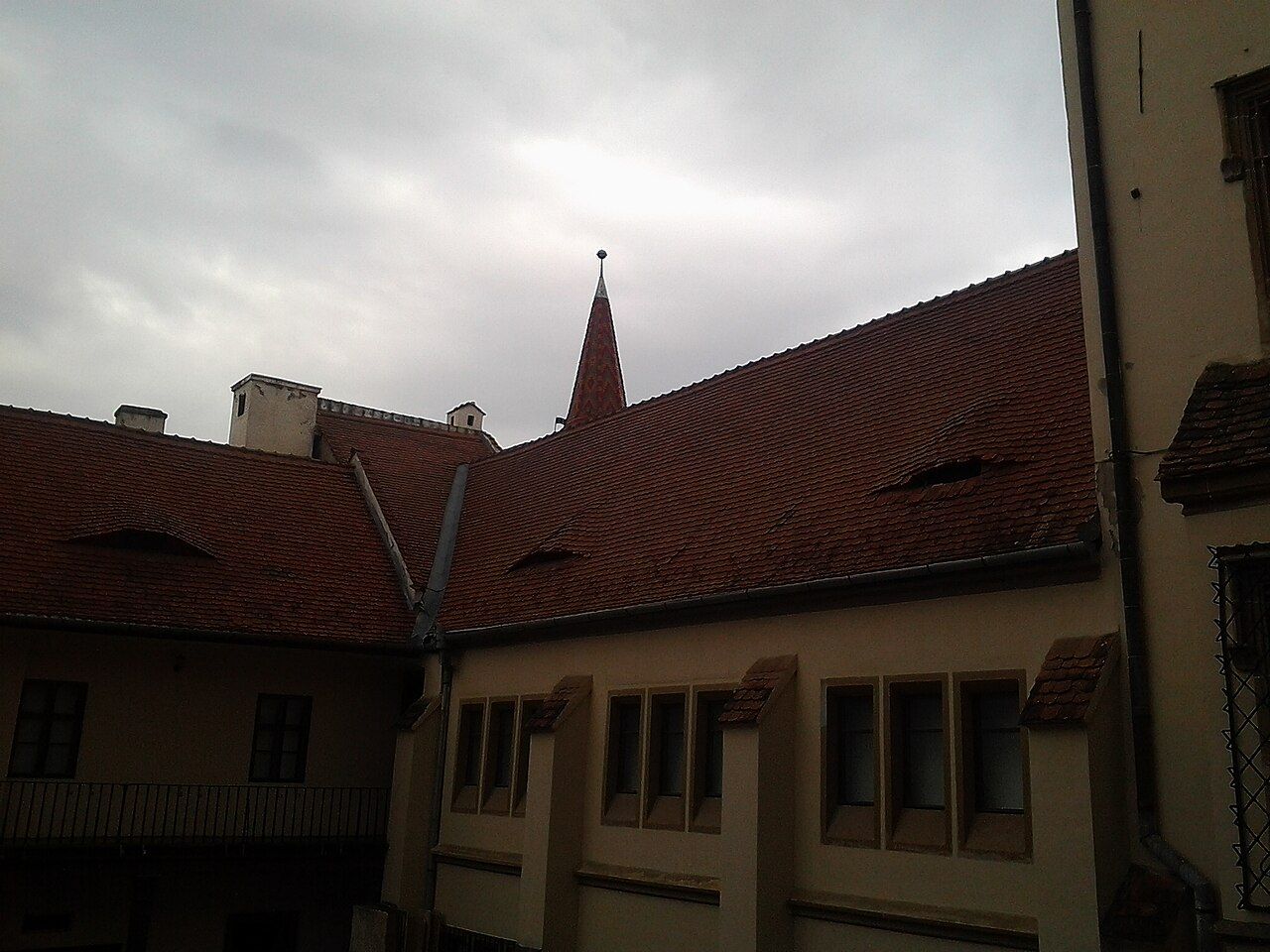
Walls, towers and stairways
Sibiu was ringed by several lines of walls, and the best surviving stretch runs along Strada Cetății. Three towers stand along it, named after the guilds that were responsible for defending them: the carpenters, the potters and the harquebusiers. Walking the street on a quiet morning, with the wall and its towers at your side, gives you a sense of how much effort the town put into keeping itself safe.
Elsewhere, fragments of wall turn up in courtyards and behind newer buildings, and old gate towers mark where roads once entered the town. The lanes of the lower town, around Piața Aurarilor, the goldsmiths' square, and the streets towards the river, are where you see Sibiu as a working place: painted houses with wide wooden gates, inner yards, and stairs climbing back towards the upper town.
Dumbrava and the villages beyond
On the southern edge of the city, in the Dumbrava forest, the ASTRA open-air museum gathers hundreds of buildings brought from villages across Romania: houses, windmills, watermills, workshops, presses and churches. It covers a large wooded area around a lake, and you need several hours and good shoes to see even part of it. It is one of the best places in the country to understand how rural life was organised, and to see village building traditions, including wooden churches of the kind found in the north, up close.
Sibiu also makes a good base. The villages of Mărginimea Sibiului, along the foot of the mountains to the west, have kept shepherding and old crafts. To the north, the Saxon fortified churches around Biertan are within an easy day. To the south the Olt valley cuts through the Carpathians towards Wallachia, and to the south-east the high road over the Transfăgărășan climbs to Bâlea Lake in the warmer months. If you go into the mountains, remember that brown bears live there: never feed them, keep your distance and follow local warnings.
The approach to Sibiu
Sibiu has an airport and is on the rail network, and road links to Bucharest, Brașov and Cluj have improved with new motorway sections. Once you arrive, the old town is best on foot, and city buses connect the railway station, the centre and the outer districts, including Dumbrava.

Sibiu has a busy calendar of festivals, especially theatre in early summer, and the main square fills with a market in December. Those weeks bring crowds and fuller beds, so plan ahead. Spring and early autumn are calmer and still mild. Winters are cold and often snowy, and the town looks fine under snow, but some sights keep shorter hours.
Plan on at least two full days for the town itself and another for Dumbrava or the villages. Weekends bring visitors from across Romania, so the squares are liveliest then, and quietest early on weekday mornings. Whatever the season, come back to Piața Mare as the lights come on along the facades, when the roofs above seem to watch the square empty out.
The photographs on this page are credited, with their licences, on threads and photographers.